Table of Contents
The Heidelberg’s importance to Hodges
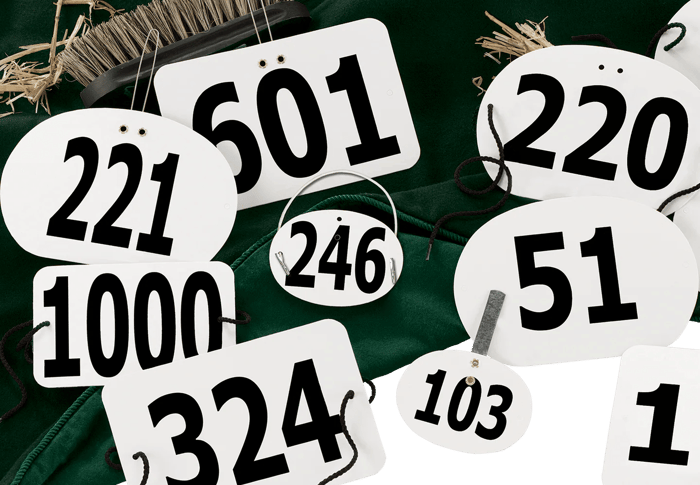
Over the past 100+ years many innovations have been utilized at Hodges to continuously improve the manufacturing of quality award ribbons and our waterproof Riders Numbers.
We take pride in utilizing the latest technology and have developed some of our own proprietary equipment as well, but we still rely on equipment that has been meticulously maintained over the decades.
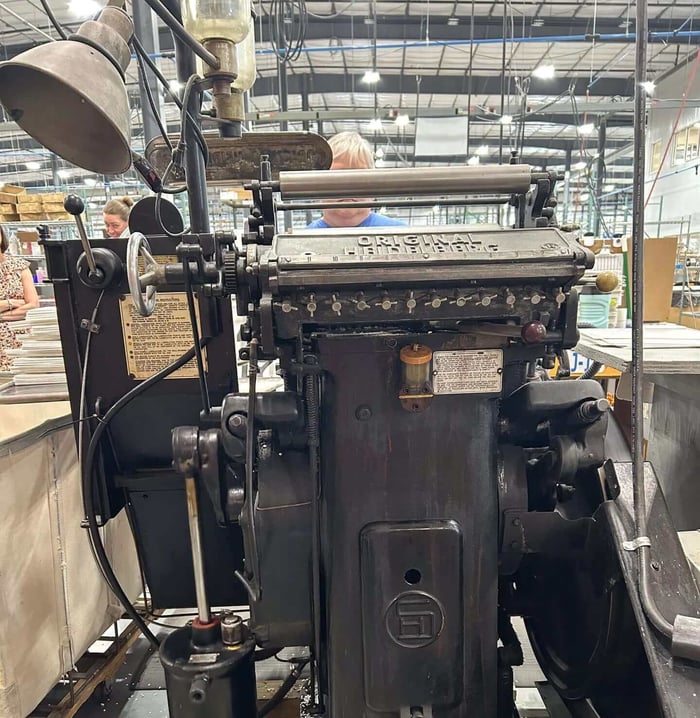
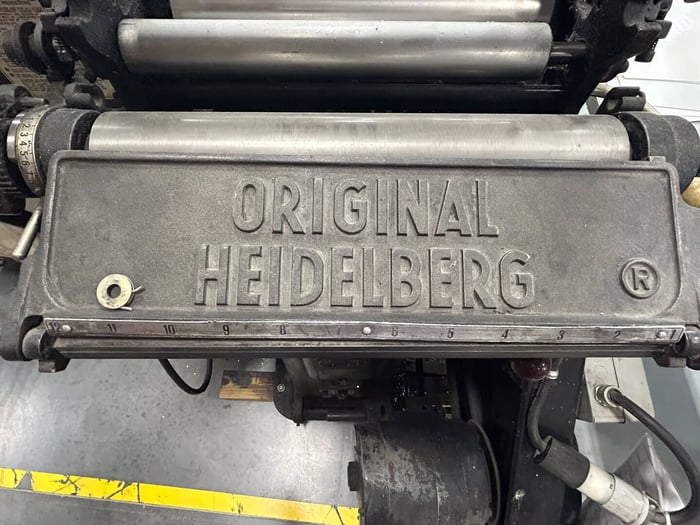
The Heidelberg press has played an important role at Hodges, with six Heidelberg 10" x 15" Windmill presses purchased over the years. This design is one of the most famous and widely used platen printing presses in the history of letterpress printing. Manufactured by the Heidelberger Druckmaschinen AG, this press became an industry standard due to its reliability, speed, and versatility.
We first purchased a 10” x 15” Windmill press to replace an ancient Chandler & Price press that was made in the very early 1900’s. We needed the strength and durability of the Heidelberg to handle the heavy weight (24 point) waterproof board that we were printing and cutting to make exhibitor numbers. We have used Heidelberg Windmill presses to print and cut numbers for at least 40 years.
Using the Heidelberg for Hodges’ unique printing application
Using the Heidelberg Windmill presses to print and cut Hodges exhibitor numbers took a little Hodges’ creativity to make this work. You see, the big problem with printing on waterproof board is that the paper is loaded with resin, and this keeps the ink from soaking into the paper fibers. If you print waterproof board with normal inks, you can wipe your printing off weeks later. Nothing sticks.
To counter this, we began printing ‘Tough Tex’ ink using the Heidelberg Press. This ink has the wonderful quality that it dries in about 15 minutes! Using this ink required careful planning and scheduling – because if our printer operators went to lunch and left the ink on the machine, when they came back it was cured – and it was a devil to get off of everything!
History & development
- 1914: Heidelberg introduced its first platen press.
- 1923: The Heidelberg "Automatic Platen Press", later known as the Heidelberg Windmill, was introduced at the Leipzig Trade Fair. It revolutionized printing by automating the feeding and delivery of sheets.
- 1926-1930s: Further refinements were made to the machine, making it faster and more efficient.
- 1950s-1960s: The 10" x 15" Heidelberg Windmill became the dominant press for small to medium-sized print shops worldwide.
- 1974: Production of the Windmill press ended as offset printing became the industry standard.
- Today: Despite being discontinued, the Heidelberg Windmill is still widely used for specialty printing tasks, such as die-cutting, embossing, numbering, foil stamping, and high-quality letterpress work.
Features & innovations over the years
- "Windmill" Gripper Arms: The press is named after its unique windmill-style grippers, which rotate to pick up and deliver sheets, ensuring continuous operation.
- Automatic Feeding & Delivery: The press can handle a range of paper stocks, from thin sheets to heavy cardstock.
- High-Speed Operation: Capable of up to 5,000 impressions per hour.
- Precision & Versatility: Used for printing, scoring, perforating, die-cutting, embossing, and foil stamping.
The future
It has only been in the last few years that increasing volumes of numbers being sold forced us to switch to a rotary die cutting system. We still keep two of the old presses around because you never know when one is going to need to be pressed into service.
FAQs
Are Hodges exhibitor numbers still made in the USA?
Yes — every exhibitor number is manufactured at our facility in Washington, Missouri. We've invested in both time-tested equipment, including restored Heidelberg presses kept on standby, and modern rotary die-cutting systems to meet growing demand without sacrificing consistency. Buying American-made means faster turnaround, direct access to our team if questions come up, and confidence that your order isn't sitting in an overseas shipping queue. Contact us to learn about lead times for your event.
How long has Hodges been manufacturing exhibitor numbers, and does that experience affect what I receive?
Hodges has been printing and cutting exhibitor numbers using Heidelberg Windmill presses for over 40 years, and the company itself has been in operation for more than a century. That depth of experience shows up in the details, from the ink formulation we developed to handle waterproof board, to the proprietary equipment we've built in-house over the decades. When you order from Hodges, you're getting a product refined through generations of hands-on manufacturing, not outsourced production. Reach out to discuss bulk pricing or custom specifications for your next event.
What makes Hodges' exhibitor numbers waterproof, and why does that matter for my event?
Hodges prints rider and exhibitor numbers on a heavy 24-point waterproof board using a specialty ink called Tough Tex, which bonds to resin-coated paper that standard inks simply can't hold. The result is a number that stands up to rain, sweat, and outdoor conditions without smearing or fading. For show managers and event organizers, that means fewer complaints from exhibitors, riders, and participants. If you're sourcing numbers for an upcoming show, our team can walk you through size and quantity options to fit your event.