Table of Contents
Every summer, the same question echoes across fairgrounds: "Wait, why did they both get blue ribbons?" If you're a 4-H leader, fair superintendent, or first-time exhibitor's parent, understanding the county fair 4-H ribbon colors system is essential. Not just for answering questions, but for ordering the right ribbons before your fair opens. At Hodges Badge, we've been supplying 4-H ribbons and fair award ribbons since 1920, and we've answered this question more times than we can count. This guide breaks down exactly what each color means, how the Danish judging system works, and what every fair leader needs to know before placing their ribbon order.
How the 4-H Ribbon Colors System Works
Most county fairs and 4-H programs use a system called the Danish method of judging. Unlike a traditional competition where a judge ranks every entry against each other, 1st, 2nd, 3rd, the Danish system evaluates each entry against a set standard for that project class.
That means two quilts, two pies, or two garden projects can both receive a blue ribbon, because the judge is asking "Does this entry meet the standard?” not "Which entry is better?" It's a fundamentally different philosophy, and one that works especially well for youth development programs where learning and growth are the goal.
The 4-H ribbon colors result is a ribbon system built around four colors: purple, blue, red, and white , each representing a level of achievement against the project's official standards. These colors are recognized across 4-H programs nationwide, and Hodges Badge has been producing them to exacting standards, made in the USA, for over 100 years.
What Each Ribbon Color Means
Here's a breakdown of the four 4-H ribbon colors and what each one signals to an exhibitor and their family:
Ribbon Color | Designation | What It Means | Number per Class |
Purple | Superior / Outstanding | Exceeds all standards, the highest rating | Up to 1 (judge's discretion) |
Blue | Excellent | Exceeds most standards, minor improvements possible | Multiple per class allowed |
Red | Good | Meets minimum standards, some room to improve | Multiple per class allowed |
White | Needs Improvement | Did not meet minimum project standards | Multiple per class allowed |
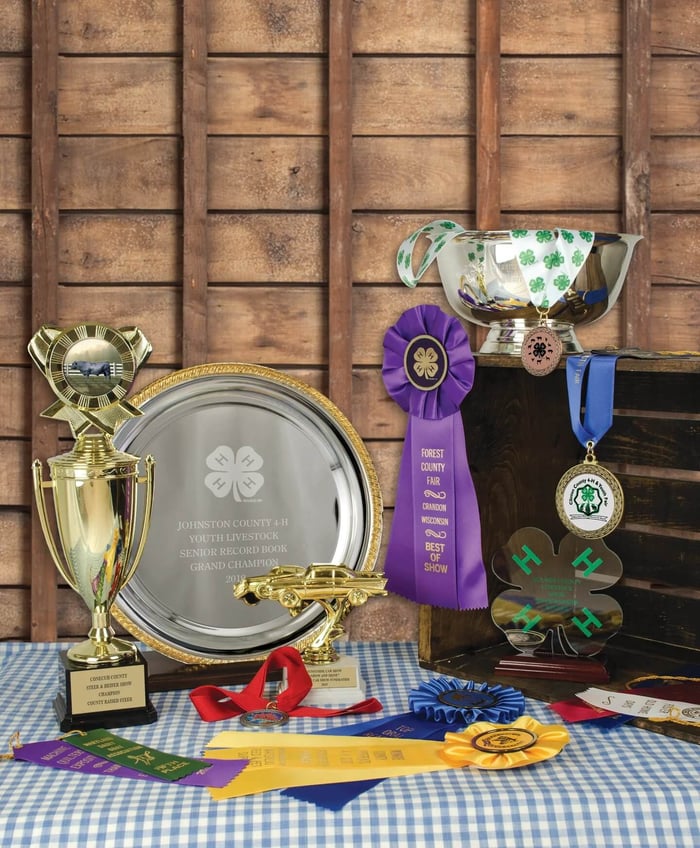
Purple — Superior or Outstanding: The purple ribbon is the highest recognition in the Danish system. It means the exhibit doesn't just meet the standards, it exceeds them in an outstanding way. Not every entry earns a purple ribbon. In fact, a judge may award zero in a class if no entry rises to that level. When a 4-H member earns a purple, it's a genuine achievement worth celebrating. A well-made purple ribbon from Hodges Badge, crisp, color-true, and American-made, is one that ends up framed.
Blue — Excellent: A blue ribbon means the exhibit exceeds the minimum standards for the class. The work is solid, shows real skill, and has only minor areas for improvement. Blue ribbons are the most common ribbon at a well-run fair and represent the standard every 4-H member is working toward.
Red — Good: A red ribbon means the entry meets the basic standards but has visible areas for improvement. It's not a discouraging ribbon, it signals that the exhibitor understood the project requirements and completed the work, with room to grow. Many first-year exhibitors earn reds as they learn, and they're back next year with better projects.
White — Needs Improvement: A white ribbon means the entry did not meet the minimum standard for the class. White ribbons are typically accompanied by written feedback from the judge, giving the exhibitor a clear picture of what to work on before next year's fair.
One important note: terminology varies by state and fair program. Some use 'Merit' (purple), 'Good' (blue), 'Fair' (red), and 'Poor' (white). Others use A through D grades. Always check your state's 4-H program guidelines for the language used in your specific fair.
Champion and Grand Champion: Beyond the Color System
The four color ribbons are just the beginning. After all entries in a class have been evaluated, judges look across the purple-ribbon winners to select a Champion and Reserve Champion. These special awards sit above the regular color system, they're not a different shade, they're a different category entirely.
Champion Ribbon: Awarded to the single best entry among all purple-ribbon winners in a class or department. If no purples were awarded, the champion may be selected from blue-ribbon winners.
Reserve Champion: The second-best entry in the class or department, just behind the champion.
Grand Champion: At many fairs, there's a final judging round across all department champions to select a single Grand Champion for the entire fair. This is the most prestigious ribbon at the event, and the one that ends up in the most photographs.
Champion and Grand Champion ribbons are the awards that last a lifetime. At Hodges Badge, our rosette-style champion awards are handcrafted in the USA with the same care and quality we've brought to the fair community since 1920. When a young exhibitor wins a Grand Champion at their county fair, that ribbon goes on the wall, and it deserves to look the part for decades. Browse our champion rosette options here.
Why the Danish System Is Fairer Than You Think
Parents new to the 4-H world sometimes wonder: "Why did my child and three others all get the same ribbon?" The Danish system can feel counterintuitive if you're used to traditional competitive formats. But there are good reasons it's been the standard for 4-H programs for decades.
- It evaluates effort and learning, not just talent. A first-year exhibitor who meets the standard earns the same ribbon as a veteran who meets the standard. That's by design.
- It gives judges flexibility. Not every class has a clear 'best.' The Danish system lets judges recognize genuine quality without forcing artificial rankings between unequal entries.
- It reduces discouragement. In a traditional ranking system, every exhibitor except first place 'lost.' Under Danish judging, multiple exhibitors can be recognized for real achievement.
- It aligns with 4-H's mission. 4-H is a youth development program, not a competitive sport. The ribbon system reflects that priority, growth, learning, and leadership over winning.
The system works best when fair leaders communicate clearly what each ribbon color means, to exhibitors, parents, and spectators. Posting a simple ribbon color guide at your fair's entry area, or including one in your fair book, goes a long way. (Feel free to share this article as your reference.)
What 4-H Leaders Need to Order (and When)
If you're organizing the ribbons for a county fair or 4-H event, here's a practical checklist, and the ordering timeline that will keep you on deadline
Color ribbons (bulk):
- Purple, blue, red, and white placing ribbons for every class
- Estimate generously, running out mid-fair is far worse than having extras
- Custom printed with your fair name, year, and county is standard; Hodges Badge can help you design these from scratch or match your existing look
Champion and special award ribbons:
- Champion rosette, one per department
- Reserve Champion rosette, one per department
- Grand Champion rosette, one for the overall fair, if applicable
- Best of Show, Most Educational, Most Creative, if your fair uses these categories
Ordering timeline:
- For July–August fairs: order no later than mid-June
- For September fairs: order by late July
- Custom printed color ribbons: allow 3 weeks
- Rosettes and champion awards: allow 4 weeks
 Hodges Badge has been a trusted partner to county fairs, state fairs, and 4-H programs since 1920, and as a family-owned, American-made company, we take that relationship seriously. Our 5-star customer service team is available to help you plan your order, whether you need to purchase ribbon in the 4-H ribbon colors or you're buying ribbons for a small club fair or a large state event. We'll confirm your lead times upfront, walk you through design options, and make sure you have exactly what you need before your fair opens. Start your order at hodgesbadge.com.
FAQs
Why do multiple kids get the same color ribbon at the county fair?
County fairs and 4-H events use the Danish judging system, which evaluates entries against a set standard rather than ranking them against each other. If three entries all meet the standard for a blue ribbon, all three receive one. This approach rewards genuine achievement and growth, which is exactly what 4-H is about.
What does a purple ribbon mean at a 4-H fair?
A purple ribbon is the highest award in the Danish system, signifying that the exhibit was outstanding and exceeded all standards for its class. Judges are not required to award purple ribbons, they're earned, not given. Purple ribbon winners are then evaluated to select a Champion and Reserve Champion for the department.
Where can I order 4-H ribbons for my county fair?
Hodges Badge has been supplying fair and 4-H ribbons since 1920, and as a family-owned, American-made business, we understand what fair leaders need. You can browse our fair and 4-H ribbon collection online or contact our 5-star customer service team for custom orders. We offer full custom printing with your fair name, year, divisions and county, and we recommend ordering 4–6 weeks before your event to save you money on any rush services. Our team will walk you through every step.
Can you get more than one blue ribbon in a 4-H class?
Yes! That's one of the defining features of the Danish system. Multiple entries in the same class can all receive blue ribbons if they all meet the standard for excellent work. The number of blue ribbons awarded depends entirely on the quality of the entries, not on a fixed quota.
How far in advance should I order 4-H ribbons for my county fair?
Plan to order at least 4-6 weeks before your fair date. County fair season peaks July through September, which means June and early July are the busiest ordering windows. If your fair is in August, place your order no later than late June to avoid rush services. Custom printed ribbons with your county name, fair name, divisions or classes and year need time for design approval and production. Contact Hodges Badge early and we'll confirm your lead time and details upfront.